KickBass Heavy Lifter – Stand By
A liftoff of the KickBass Heavy Lifter would look, sound, and feel completely different from any rocket launch in human history. Because it uses solid-state digital induction matrix instead of burning standard chemical propellants, it would be a blinding, high-tech spectacle.
Here is exactly what you would experience standing a safe distance away from the launch pad.
1. T-Minus 60 Minutes: The Silent Spin-Up
An hour before launch, there is none of the heavy, billowing white frost or boiling vapor clouds that you see on a SpaceX or NASA rocket. The insulated jackets perfectly trap the hyper-cold cryogenic backup fuels inside the outer pads.
- The Underground Hum: The only sound is a low, deep, bass-heavy vibration coming from the concrete floor beneath the pad. Deep underground, the massive magnetic-levitation flywheels are receiving their final pulses of electricity, spinning at optimal speed inside their vacuum vaults, completely loaded with megawatts of kinetic energy.
2. T-Minus 10 Seconds: The Water Deluge
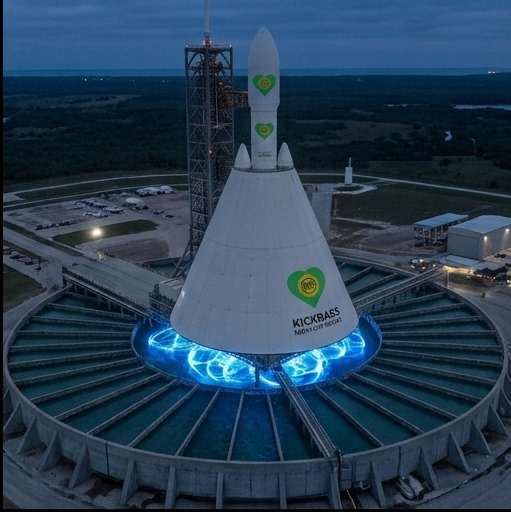
A massive wall of water floods the concrete trenches beneath the launch pad. Because firing all engines simultaneously creates a cataclysmic acoustic shockwave, this water layer is critical to swallow the sound waves before they can bounce back and vibrate the rocket’s walls to pieces.
3. Ignition: The Blue Storm
When the countdown hits zero, the underground flywheels instantly discharge their stored energy into the multi-tube matrix.
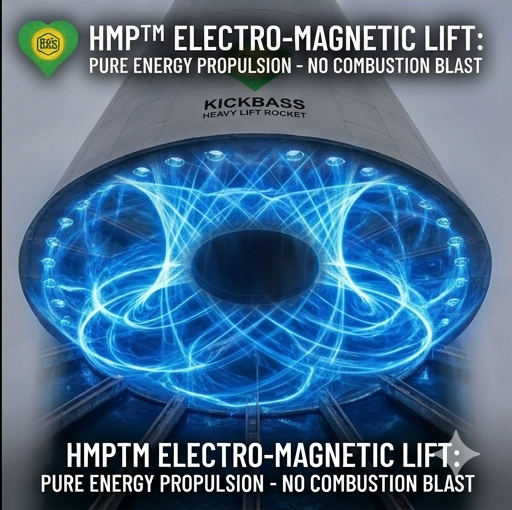
- The Visuals: There is no massive orange fire or thick black smoke. Instead, you see a blinding, electric-blue and violet glare flashing out from the bottom of the pads. This is the visual signature of the solid-state digital induction arrays inside each tube firing rapidly generating its high-energy plasma matrix.
- The Sound: Instead of the low, rumbling roar of a chemical rocket, the KickBass Heavy Lifter creates an incredibly high-frequency, metallic tearing sound. This is the sound of plasma detonations happening every single second.
4. Liftoff: The Digital Thrust Ascent
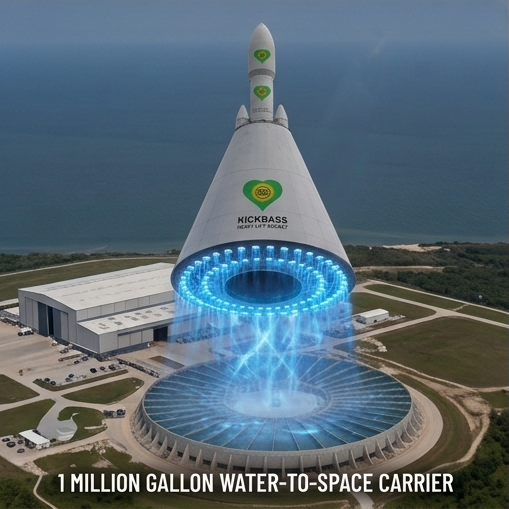
As the superconducting magnetic coils turn on, they grab the glowing plasma and slam it out of the nozzles using the Lorentz Force. The rocket clears the tower with absolute precision.
- The Software Balance: Because the rocket has multiple individual “pixels” of thrust, you don’t see any moving mechanical steering fins or swinging engine nozzles. The rocket ascends perfectly straight, looking completely rock-solid. If a gust of wind hits the tower, the onboard flight computer micro-throttles specific tubes in the grid, correcting the trajectory in microseconds purely through digital fluid pressure.
- The Clean Exhaust: Looking up at the climbing vehicle, the exhaust plume is a beautiful, glowing white-blue trail. Because the primary fuel is water, the rocket leaves behind nothing but a clean, rapidly dissipating mist of superheated steam.
5. Transition to Mach 5+: The Air-Breathing Scream
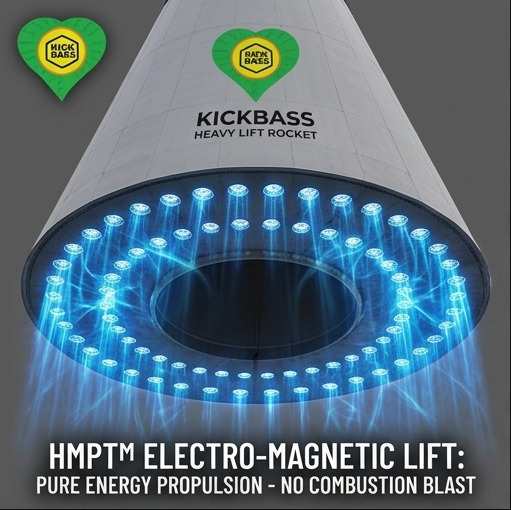
As the rocket punctures the sound barrier and screams into the upper atmosphere, the magic of the design takes over. The flight computer shuts down the inner fuel injectors of the center pad, opening it up completely.
- The Hypersonic Intakes: Oncoming atmospheric air rushes straight through the hollow center core of the vehicle. The air compresses itself violently inside the tube, and the outer propulsion panels begin “seeding” the passing air stream to turn it into a plasma vortex.
- The Final View: To a spectator on the ground, the rocket transforms into a brilliant, glowing streak of light, breathing the very atmosphere to accelerate to hypersonic speeds (Mach 5+) as it effortlessly punches its way into orbit.
6. The Result – Great Fuel Mileage!
- The ship reaches the borders of space in 9 minutes on 20 Gallons of water!